
 RSS Feed (xml)


From Wireless waffle,
How to listen UFOs
An interesting title which provocate us to read. A blog posting with unique topic
make our eyes catch to read 'em. Here are the post:
Since the late 1990's rumours have abounded that it was possible to hack into American military satellites and use them for wide area communication. The satellites, originally the 'FleetSatCom' newtork (often abbreviated to FLTSATCOM) use basic FM modulation and have uplinks in the area of 300 MHz and downlinks in the area of 260 MHz. Stories went that tuning in to the downlinks it was possible to hear illegal pirates, from Brazil in particular, who were usurping these US military satellites to use for wide-area communications. It was also said that 'Smile 93.9 FM' (rumoured to be from Manila) was using one of the channels as a studio to transmitter link and could often be heard on the downlink frequency of 269.950 MHz.
This seemed a little far fetched and unbelievable: How could one of the world's most super-sophisticated armed forces allow their multi-million dollar military hardware be taken control of by such an unsophisticated enemy armed with nothing more than a simple UHF FM transmitter? Using a simple VHF/UHF receiver and a bog standard roof mounted VHF/UHF antenna, I set out to try and debunk the myth.
Within seconds I was listening to a conversation between two likely sounding chaps on a frequency of 255.550 MHz. Next I stumbled across more voice traffic (definitely in Portuguese, the language spoken in Brazil) on 258.650 MHz. And before long I found more voice traffic on 253.850 MHz. Intrigued that this long reported phenomena was still in evidence I did a bit of digging on the internet to find out more.
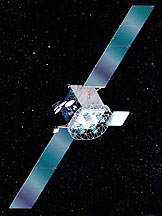
The original FleetSatCom satellites which were launched in the late 1970's and early 1980's are no longer operational. They were initially replaced by satellites known as Leased Satellites (Leasat) which have also since been replaced by the UHF Follow-On series of satellites, ironically acronymised as UFO. The UFO satellites continue to provide the same communications capabilities as the earlier ones but with somewhat higher transmitter powers, making reception of them fairly straightforward.
A bit more digging uncovered military standard MIL-STD-188-181A which describes the interface specification for the satellites (i.e. the technical requirements for equipment used to access them) and in it we find a list of the uplink and downlink frequencies used. All the frequencies I could hear are in group 'Charlie', now known as group 'Quebec' (Q) on the UFO satellites. Group Q comprises the following 25 kHz wide downlink frequencies (uplink frequencies are 41 MHz higher):
images ufo fltsatcom jpgQ1 250.650 MHz (Fleet Broadcast)
Q2 252.150 MHz (Navy Channels)
Q3 253.850 MHz
Q4 255.550 MHz
Q5 257.150 MHz
Q6 258.650 MHz
Q7 265.550 MHz
Q8 267.050 MHz
Q9 269.450 MHz
Q10 269.950 MHz
Q11 260.625 MHz (DoD Channels)
Q12 260.725 MHz
Q13 262.125 MHz
Q14 262.225 MHz
Q15 262.325 MHz
Q16 262.425 MHz
Q17 263.825 MHz
Q18 263.925 MHz
So far, I have heard sporadic voice traffic on channels Q2, Q3, Q4, Q5 and Q6 and something, albeit rather weak on Q7. It seems as if the satellite I am hearing is UFO-7 which is situated over the Atlantic. But is this traffic really pirates using the satellites on purpose, or is it something else? Surely there is no longer the need, in Brazil or other countries, to use US military satellites for communications, especially now that mobile phones and mobile coverage are virtually ubiquitous?
A quick look at the Brazilian frequency allocation table, the Plano de Destinação de Faixas de Freqüência, shows us that the frequency range 270 - 326.8 MHz is assigned to the fixed and mobile service, and in particular to public correspondence. So the frequencies are quite legally in use for various communication services; that they are being relayed by the satellite is incidental and a result of the fact that the uplink frequencies are used differently in different parts of the world. So no Brazilian pirate radio mafia trying to jam US military satellites after all then? What a shame, it seemed like such a good story.
Originally posted by admin of Wireless Waffle on Friday 31 August, 2007, 10:48 - Pirate/Clandestine
Read more!


 Posts
Posts


