Subscribe

RSS Feed (xml)

Powered By

Skin Design:
Free Blogger Skins

Powered by Blogger

Network Security Map Network Protocol Map

Friday, June 27, 2008

One of the most I've been waiting for

This article on silicon.com remember me what i've been present on my post-graduate class a few years ago. I got my interesting assignment to present a future technology f telecommunications. Here are the article :


Holograms on handsets by 2010

Forget 3G, mobiles go 3D

Holographic mobile handsets capable of projecting, capturing and sending 3D images have been developed by an Indian tech company.

By 2010 the devices will routinely beam 3D films, games and virtual goods into our laps according to Indian technology giant Infosys, which has patented the handset.
The portable machines will capture and send 3D snapshots of the surrounding world, helping accident investigators, teachers and doctors work remotely by instantly relaying realistic depictions of car damage, injuries, medical scans or educational aids.

The powerful onboard processor on the Infosys machine would build a series of 2D shots taken, for example, from a digital camera, into 3D holograms using algorithms called 'Fourier' transformations to calculate the extra third dimension.

The patent, granted by the US Patent and Trademark Office, says this allows complex 3D holographic images to be squeezed through the narrow pipes of existing communications networks, by sending only the unprocessed data to be translated into the 3D hologram at the other end.

Infosys' device will be able to both send and receive these 3D images, displaying them using a projector with a laser source and micro holographic optical elements lenses.

The global 3D screen market is forecast by industry to grow to 8.1 million units by 2010.

A spokeswoman for Infosys said: "Holographic handsets have the capability of enriching the user experience, with an actual 3D experience and higher quality images. This gives users a more realistic experience in areas like gaming, medicine, movies etc."

She said the technology would enable 3D images to be displayed without losing resolution, something that is not possible using current 3D technology, such as stereoscopic displays.

Originally posted By Nick Heath

Published: 19 June 2008 11:17 BST

This remarkable technology as I remember firstable introduced by NTT DoCoMo Japan through their film of Vision 2010, and it said that they plan to deploy it on 2012. We can see their newest video of Vision 201X now.It was an interesting promo movie that explore my knowledge much better. The requirement of 500MBps bandwidth to held the communication become a challenging part. Who would be the first?


Read more!

Wednesday, June 25, 2008

A new world called VHDL

A few years ago, actually about 1.5 years ago when I have to choose my theses topic, I start to collect much resources about that. And it end when I choose on Broadband Powerline Communication topic. I decided to make a simple modulator demodulator for that kind communication. Maybe it's not a new topic. But i myself have my dreams on that. A prestigious dreams that i hope it can change much of my way of life.
When I decided it, i again collected much resource on how to do it. And i got a new world called VHDL. A Hardware Description Language use to design a digital hardware. This programming language is one of the unpleasant choice for designing such hardware like what I choose one. To make a modem we have to know many theoretical things first.
I hope somebody can directly guide me on my program.
Till now , i haven't finish my program yet. I still hard to find it's detail solution.
And this blog is one of my effort to share and solve my problems. I hope many hardware designer will help me much to finish my graduation. Soon I'll post my program to share others. Before I do that, i'd like to thanks all visitors that have come to my blog.


Read more!

Sunday, June 22, 2008

Between DAB and DVB from Wiki, Try World Radio and TV tuner below!

Digital Audio Broadcasting (DAB), also known as Eureka 147, is a digital radio technology for broadcasting radio stations, used in several countries, particularly in Europe. As of 2006, approximately 1,000 stations worldwide broadcast in the DAB format[1].

The DAB standard was designed in the 1980s, and receivers have been available in many countries for several years. Proponents claim the standard offers several benefits over existing analogue FM radio, such as higher-fidelity audio, more stations in the same broadcast spectrum, and increased resistance to noise, multipath, fading, and co-channel interference. However, listening tests carried out by experts in the field of audio have shown that the audio quality on DAB is lower than on FM in the UK, which is the country that accounts for the vast majority of global DAB sales-to-date, due to 98% of stereo stations using a bit rate of 128 kbit/s with the MP2 audio codec, which is unable to match the audio quality provided by FM.[2][3][4]

An upgraded version of the system was released in February 2007, which is called DAB+. DAB+ is not backward-compatible with DAB, which means that only receivers that support the new standard will be able to receive DAB+ broadcasts. DAB+ is 2 - 3 times more efficient than DAB due to the adoption of the AAC+ audio codec[5], which means that DAB+ can provide higher audio quality and more radio stations than DAB allows. Reception quality will also be more robust on DAB+ than on DAB due to the addition of Reed-Solomon error correction coding.

Italy has started transmitting DAB+ stations, Malta and Switzerland are due to launch DAB+ stations in 2008, and Australia and Germany planning on launching DAB+ in 2009. The radio industry in the UK is expecting DAB+ stations to launch between 2010 - 2013[6], and podcast services using the DAB+ format will be launched in the UK in 2009[7].

Digital Video Broadcasting (DVB) is a suite of internationally accepted open standards for digital television. DVB standards are maintained by the DVB Project, an industry consortium with more than 270 members, and they are published by a Joint Technical Committee (JTC) of European Telecommunications Standards Institute (ETSI), European Committee for Electrotechnical Standardization (CENELEC) and European Broadcasting Union (EBU). The interaction of the DVB sub-standards is described in the DVB Cookbook (DVB-Cook).

DVB systems distribute data using a variety of approaches, including by satellite (DVB-S, DVB-S2 and DVB-SH; also DVB-SMATV for distribution via SMATV); cable (DVB-C); terrestrial television (DVB-T, DVB-T2) and digital terrestrial television for handhelds (DVB-H); and via microwave using DTT (DVB-MT), the MMDS (DVB-MC), and/or MVDS standards (DVB-MS)

These standards define the physical layer and data link layer of the distribution system. Devices interact with the physical layer via a synchronous parallel interface (SPI), synchronous serial interface (SSI), or asynchronous serial interface (ASI). All data is transmitted in MPEG-2 transport streams with some additional constraints (DVB-MPEG). A standard for temporally-compressed distribution to mobile devices (DVB-H) was published in November 2004.

These distribution systems differ mainly in the modulation schemes used and error correcting codes used, due to the different technical constraints. DVB-S (SHF) uses QPSK, 8PSK or 16-QAM. DVB-S2 uses QPSK, 8PSK, 16APSK or 32APSK, at the broadcasters decision. QPSK and 8PSK are the only versions regularly used. DVB-C (VHF/UHF) uses QAM: 16-QAM, 32-QAM, 64-QAM, 128-QAM or 256-QAM. Lastly, DVB-T (VHF/UHF) uses 16-QAM or 64-QAM (or QPSK) in combination with COFDM and can support hierarchical modulation.

The DVB-T2 standard will be published after march 2008 and is expected to be approved and submitted to ETSI during 2008.

The DVB-T2 standard will give more-robust TV reception and increase the possible bit-rate by over 30% for single transmitters (as in the UK) and is expected to increase the max bit-rate by over 50% in large SFN (as in Germany, Sweden...).

Besides audio and video transmission, DVB also defines data connections (DVB-DATA - EN 301 192) with return channels (DVB-RC) for several media (DECT, GSM, PSTN/ISDN, satellite etc.) and protocols (DVB-IPTV: Internet Protocol; DVB-NPI: network protocol independent).

Older technologies such as teletext (DVB-TXT) and vertical blanking interval data (DVB-VBI) are also supported by the standards to ease conversion. However for many applications more advanced alternatives like DVB-SUB for sub-titling are available.

You all may try this technology by installing this World Radio and TV Tuner software for free trials. Or you just wanna rip your favourite music from different Internet radio stations over the world.


Read more!

Thursday, June 19, 2008

Japanese robot companies join forces to compete with South Korea

South Korea has already made its ambitious robot plans quite well known, and it now looks like a group of Japanese robot companies are doing their best to stay in the race, with them forming a consortium of sorts that they say will let them cooperate in the research, development and marketing of robots. Currently, that group includes Tokyo's ZMP, Nagoya's Business Design Laboratory, Vstone (makers of the Black Ox pictured above), and Tmsuk, each of which will apparently initially focus on "simple service robots" designed to keep watch on the elderly, pets, and children. They're not getting much more specific than that just yet, unfortunately, with one of the company's CEOs only going so far as to say that, "in ten years, robots may be able to help out around the house," but that he doesn't "necessarily know that robots should do everything."
Originally posted by Donald Melanson, on Jun e, 18th 2008 at 2:33PM

Looks like a robot revolution will begin soon. Hope everyone can take a good benefit from them. And I hope it won't make such a big destruction as on Transformer movies.


Read more!

Monday, June 16, 2008

Wireless and Cellular Communication by William C.Y. Lee

Publisher: McGraw-Hill Professional
Number Of Pages: 821
Publication Date: 2005-10-22
Sales Rank: 178562
ISBN / ASIN: 0071436863
EAN: 9780071436861
pass: gigapedia.org
Binding: Hardcover
Manufacturer: McGraw-Hill Professional
Studio: McGraw-Hill Professional
Average Rating: 4


The #1 book on wireless communications has been completely updated

World recognized wireless authority William Lee delivers all new in-depth engineering coverage for data sevices, Wi-Fi, 3G, and much more, just in time for the rebounding wireless industry.

Includes specifications for all major wireless systems, including cdmaOne

link for free download: mihd.net

Good book for newbie at Mobile and Cellular Telecommunication. It'sRecommended.

Undergoing MyBlogLog Verification


Read more!

Sunday, June 15, 2008

Public Broadcast Cart

  • Public Broadcast Cart
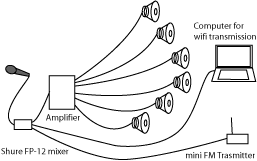
  • is a shopping cart outfitted with a dynamic microphone, a mixer, an amplifier, six speakers, a miniFM transmitter and a laptop with a wireless card. The audio captured by the microphone on the cart is fed through the mixer to three different broadcast sources. The mixer simultaneiously feeds the audio:

    * to the amplifier that powers the six speakers mounted on the cart

    * to an FM transmitter transmitting to an FM frequency

    * to the laptop that sends the audio to an online server that will stream the live broadcast, such as the thing.net's server - http://radio.thing.net

    The Public Broadcast Cart is designed to enable any pedestrian to become an active producer of a radio broadcast. The cart reverses the usual role of the public from audience to producer of a radio broadcast and online content. View original proposal

    As the government and the FCC seek to hand over our media resources to the wealthiest corporate media entities looking to monopolize the media from print to radio to television, it is upto the independent producers to subvert big money domination of our culture.

    The Broadcast Cart was funded by the Franklin Furnace's Future of the Present Fund and technical assistance was given by Jan McLaughlin, Greg Gong, Dana Speigel and Darrel O'Pry. The broadcast has been supported by thing.net, Ars Electronica, Exit Art, Tesla Radio. I would like to give special thanks to Martha Wilson and Wolfgang Staehle for their work as artists, independent producers and supporters of artists, and thanks to Brooke Singer, Yuri Gitman, and Dana Spiegel the producers of the public net art event Wireless Park Lab Days, September 19th and 20th, 2003, when the Public Broadcast Cart was first presented.

    Build Your Own Radio Cart

    Use a simple dynamic microphone plugged into a simple audio mixer that allows multiple output for the audio. The Public Broadcast Cart uses an old, incredibly sturdy and handy SHURE mixer donated by Jan McLaughlin. The closest version available on the SHURE site is the FP23 Microphone Preamplifer

    Ramsey Electronics offers a great selection of affordable small transmitters from a $35 AM Radio Transmitter Kit to $300 Factory Assembled and Tested Digital FM Stereo Transmitter. The Public Broadcast Cart uses Ramsey's Professional Synthesized FM Stereo Transmitter Kit, it's an excellent learning experience to assemble your own transmitter.

    If you have a wifi equiped laptop and an open wifi node available all you need is Internet radio broadcasting software. Rogue Amoeba's Nicecast allows you to turn your own computer into the broadcasting server. A better idea is to use Nicecast to stream the audio to a server designed to handle online broadcasting.

    For immediate area audio amplification, just about anything that can recieve audio from the mixer and output it through speakers could be used, even a boom box. The Public Broadcast Cart uses the Samson SERVO 120A 120-Watt Power Amplifier that powers car speakers that have been mounted onto goose neck microphone extensions

    The Public Broadcast Cart has used a few different power sources from as poor as car batteries to as a stable power supply as the Galaxy Far Outlet Model 300S, which Gotham Sound rents for a very low price.

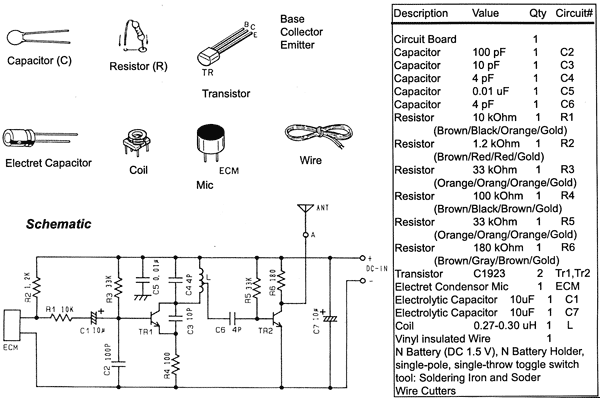
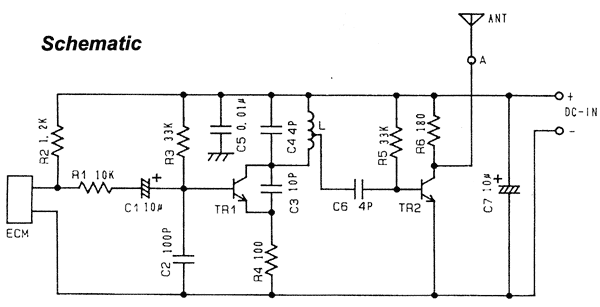
    Tetsuo Kogawa's 1 Watt Transmitter Schematic:


    Read more!
    TCP/IP Quick Guide 3G Wireless Quick Guide (electronic and printed bundle)